library(tidyverse)

fish <- read_csv("https://raw.githubusercontent.com/cobriant/teaching-datasets/refs/heads/main/fish.csv") %>%
  mutate(
    weekday = case_when(
      mon == 1 ~ "M",
      tues == 1 ~ "T",
      wed == 1 ~ "W",
      thurs == 1 ~ "R",
      .default = "F"
    ),
    weekday = factor(weekday, levels = c("M","T","W","R","F"))
  ) %>%
  select(price, quantity_sold, buyer_race, weekday, wind_speed, wave_height, day)

# 1) Visualize the distribution of the price of whiting.


# 2) Visualize the relationship between price (y-axis) and quantity sold (x-axis). Add a line of best fit with geom_smooth(method = lm).


# 3) Use a plot to answer the question, "Does price change based on the weekday?"


# 4) Use a plot to answer the question, "Does price change based on wind speed?"


# 5) Use a plot to answer the question, "Does price change based on wave height?" Add a line of best fit.


# 6) Visualize the relationship between price and buyer race.


# 7) Visualize the distribution of quantity_sold.


# 8) Use a plot to answer the question, "Do we see larger sales on some weekdays relative to others?"


# 9) Visualize the distribution of wind_speed.


# 10) Visualize the distribution of wave_height.


# 11) Use a plot to answer the question, "what is the relationship between wind speed and wave height?" Add a line of best fit.5 Fulton Fish Market with ggplot2
Start today’s class by doing the handout on ggplot2.
Then, move on to this project, where we’ll review ggplot2 by finishing our replication of Kathryn Graddy’s (2006) paper Markets: The Fulton Fish Market.
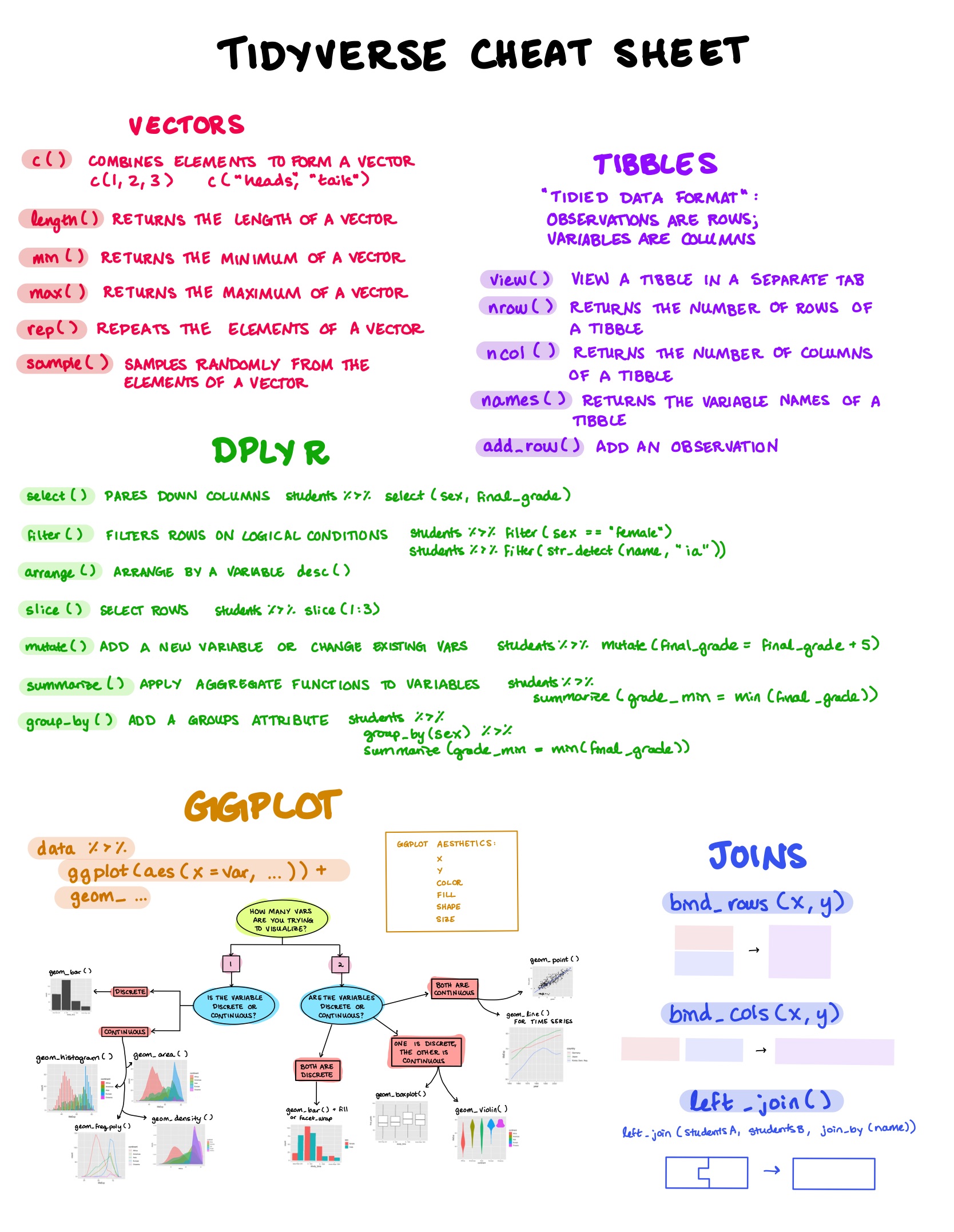
Use this cheat sheet as a reminder of the declarative programming tools we’ve learned (joins are coming up soon). In this classwork, focus on the lower left decision tree for ggplot.
Part 2: Ggplot Practice
Part 3: lm Practice
We can use lm() to fit a linear model using the method of least-squares. The syntax is lm(y ~ x + z, data = d) for the dependent variable y, the explanatory variables x and z, and data set d. Pipe the lm object into broom::tidy() to get a tidied version of the output, which can be piped into other tidyverse functions in next steps.
broom::tidy() lets you evaluate the statistical significance of the OLS estimates 3 different (but equivalent) ways: the standard error, the t-statistic, and the p-value. Let’s focus on the p-value: it tells you, under the null hypothesis (the true value of the coefficient is 0), the probability we will get an estimate as large as the one obtained, by chance (given how noisy the data is). If the p-value is less than 0.05, that means we can reject the null hypothesis at the 5% level: the explanatory variable seems to have a nonzero statistical relationship to the dependent variable, holding other explanatory variables constant.
# 1) Use lm to show that asian buyers negotiate lower fish
# prices than white buyers, holding constant the weekday,
# wind speed, and wave height.

lm(price ~ ___ + weekday + wind_speed + wave_height, data = fish) %>%
  broom::tidy()

# Interpretation: Holding constant the day of the week,
# the wind speed, and the wave height, white buyers pay
# on average ___ cents per pound more for fish
# compared to asian buyers, which (is/is not
# statistically significant).

# 2. Use lm to verify that wind speed and wave height
# predict lower quantities of fish sold at the fish market,
# holding constant weekday and buyer race.


# Interpretation: When wind speed increases by 1 mile/hr,
# quantity sold decreases by ___, which (is/is not)
# statistically significant. When wave height increases
# by 1 unit, quantity sold decreases by ___, which
# (is/is not) statistically significant.
Now you can use the function ivreg to run an instrumental variables regression: the shifters wind_speed and wave_height are instruments for price: they show the effect of the shifting supply curve, tracing out the demand curve. The coefficient on log(price) is interpreted as the percent increase in the Y variable for a one percent increase in the X variable. That is, the coefficient on log(price) is the elasticity. An elasticity of -1 means that when price increases by 1%, quantity demanded decreases by 1%. An elasticity of -2 means that when price increases by 1%, quantity demanded decreases by 2%: the consumers are elastic. An elasticity of -0.5 means that when price increases by 1%, quantity demanded decreases by 0.5%: consumers are inelastic.
install.packages("ivreg")library(ivreg)
# 3) Use ivreg to estimate the price elasticity of demand
# for asian buyers and then white buyers.
fish %>%
filter(buyer_race == ___) %>%
ivreg(log(quantity_sold) ~ log(price) + weekday | wave_height + wind_speed + weekday, data = .) %>%
broom::tidy()
fish %>%
filter(buyer_race == ___) %>%
ivreg(log(quantity_sold) ~ log(price) + weekday | wave_height + wind_speed + weekday, data = .) %>%
broom::tidy()
# Interpretation:
# - When price increases by 1%, white buyers demand ___% fewer fish.
# - When price increases by 1%, asian buyers demand ___% fewer fish.
# - Perfectly inelastic buyers have a price elasticity of
# 0: when price increases by 1%, perfectly inelastic
#. buyers demand 0% fewer fish (their demand stays exactly
#. the same).
# - Perfectly elastic buyers have a price elasticity of
#. infinity: when price increases by 1%, perfectly elastic
#. buyers demand infinity % fewer fish (their demand goes
#. to 0).
# - Asian buyers respond more to price increases than
#. white buyers: their demand is more (elastic/inelastic).
#. This makes sense because asian buyers resell fish in
#. low-income neighborhoods or use it for products like
#. fishballs, so are very sensitive to price changes. But
#. white buyers are more likely to sell to high-end
#. restaurants or suburban retailers, so they have less
#. elastic demand because they can pass higher costs on to
#. their customers.Download this assignment
Here’s a link to download this assignment.